"In the beginning, there was one thing. So the thing stretched. And as it stretched, it wiggled. And
when it wiggled, it understood it was one no more, because there was it and the wiggle. So she wiggled
more..."
— Nicolás Echaniz
The ratio as the minimal unit of information
The proportional relationship between frequencies is the minimal carrier of information.
Harmonic Information Theory follows that intuition across computation, perception, and orientation, tracing
how ratio-structured relations shape learned representation in Phideus and harmonic conditions of experience
in Beacon. The result is a research program in which harmonic structure becomes experimentally legible across
physical, biological, affective, and symbolic domains.
"Making the interference pattern of the subtle audible in the material realm."
The experiential probe of HIT — the human leg of the research. Where Phideus works
inside computation, the Beacon works inside the room and inside the body. A continuously excited string
holds open the full natural harmonic series as a living acoustic field: not a drone, but a sustained
interference pattern that listeners enter. People report melodies, voices, textures not explicitly in the
source — the Beacon takes those reports seriously as evidence. In therapeutic settings it runs alongside
PMP, opening new conditions for symbolic and affective work. Available as a 24/7 live stream.
"Do frequency ratios constitute a universal informational language?"
An AI research program testing whether harmonic frequency ratios transfer across
sensory modalities. Phideus asks whether shared ratio structure between domains enables cross-modal
recognition — independently of timbre, instrument, or absolute pitch. Cross-modality is the testbed, not
the objective. Named after Phidias, the Greek sculptor whose mastery of proportion defined classical form.
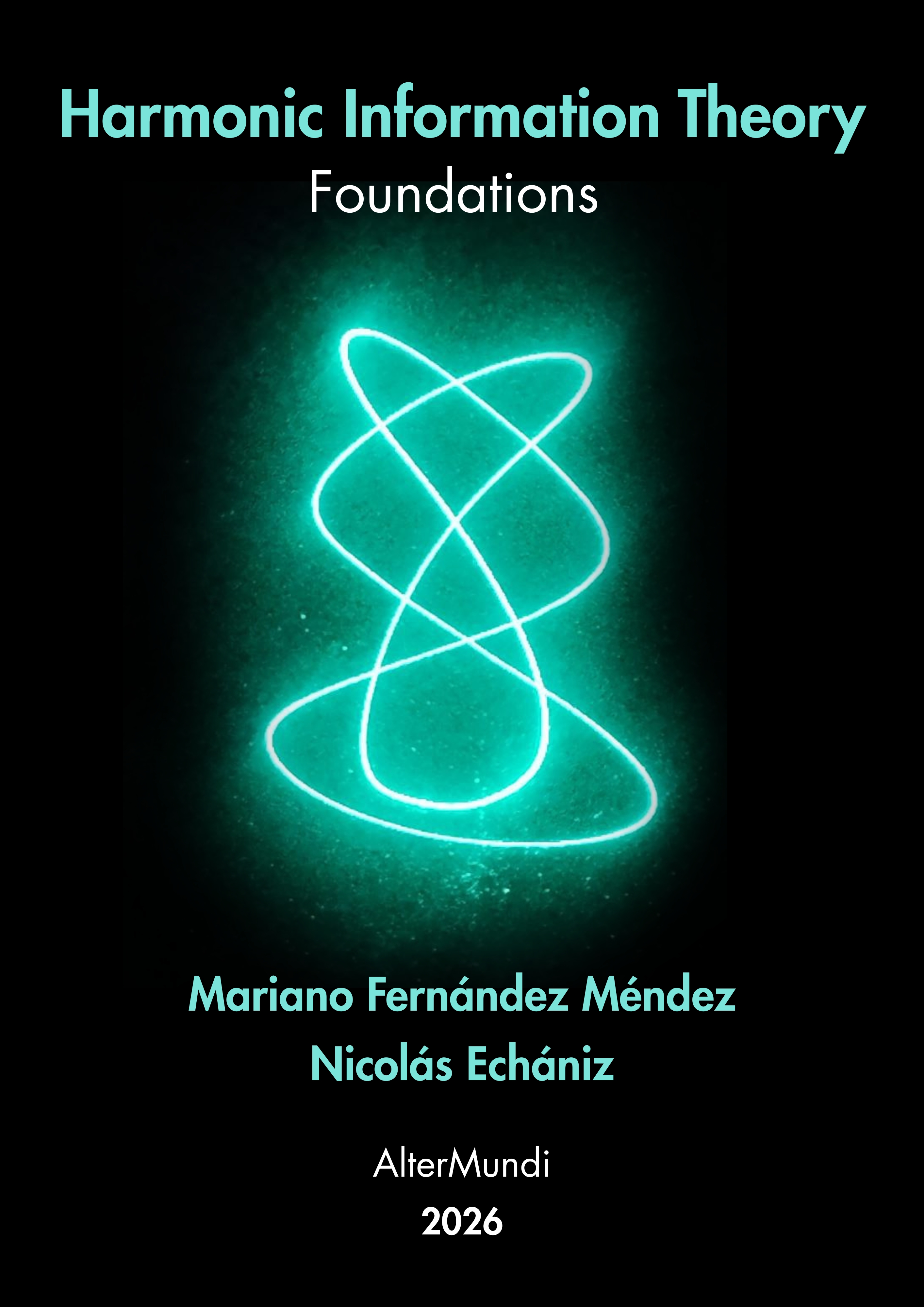
The book is available in three complementary formats. The PDF is the official bibliographic edition. The
Markdown is designed for AI reading. The LaTeX is the full editorial source.
PDF
Official first digital edition of the book with full typographic design. The ISBN
corresponds exclusively to this format.
Editorial source of the book. Contains exclusively the typographic source and editorial
materials. Not the general repository of the research ecosystem.
Mariano Fernández Méndez is a researcher, writer, and developer with a
transdisciplinary background spanning artificial intelligence, electronics, acoustics, information theory,
semiotics, and the social study of technology. Working across these fields, he has developed an approach
oriented toward connecting technical, conceptual, and epistemological questions within a shared horizon. A
member of Asociación Civil AlterMundi, he was responsible for the final compilation, writing, and
conceptual architecture of this work.
Within HIT, his contribution centers on organizing a transdisciplinary
investigation into harmonic relations and their significance for understanding information, structure, and
relation across diverse systems.
Nicolás Echaniz is an author of the book, co-founder of Asociación Civil
AlterMundi, a musician, and a researcher in the field of natural harmony. His work also spans community
networks, free software, and sovereign technologies. He leads the conceptual and technical direction of
the HIT project and created the harmonic Beacon, a device that brings the theory's hypotheses into the
realm of physical vibration.
He is the author of the founding premise: "In the beginning, there was one
thing. The thing stretched. And as it stretched, it wiggled." This formulation captures a central
intuition of HIT: the passage from unity to movement as a generative act of information. His work brings
together music, technology, and artificial intelligence to explore the harmonic structure of sound and
meaning.
Anabella SciglianoBiomedical engineering student. She contributed to the book from a physiological
and biomedical perspective, with a focus on the relationship between harmonic structures, neurological
processes, and experimental validation.GitHub →
Federico BoninoElectronics technician and sound recording operator. He contributed to the
technical and experimental development of the book through work in electronics, signal acquisition, and
acoustic processing.GitHub →
Julián De La RetaJungian-oriented psychologist. He contributed to the book through work on personal
myth projection, symbolic interpretation, and the experiential dimension of harmonic research.
Martín Fernández MéndezIndustrial designer and university lecturer. He contributed to the material and
technical development of the book through work in industrial design, mechatronics, optics, and
experimental device development.
Pablo BustosDeveloper with experience in software, electronics, mechatronics, optics, and
radiofrequency systems. He contributed to the technical development of the book and of the experimental
systems connected to the research.GitHub →
Saira AsuaVibe coding. Supported the development of the book and its experiments through
administration, organization, web hosting, and technical follow-up.GitHub →
Santiago CetránDeveloper focused on QA, monitoring, validation scripts, and technical support. He
contributed to the book by strengthening the reliability and follow-up of the experimental
systems.GitHub →
Samanta LaninSamanta Lanin es facilitadora de procesos chamánicos y meditativos, con más de 15 años de experiencia en el trabajo espiritual y la expansión de la conciencia. Su aporte al HIT integra sensibilidad, música y saberes ancestrales en la exploración de la percepción y la intención.
Get in touch
Questions about the book, contributions, collaborations,
media, or print editions — write to us at:
Asociación Civil AlterMundi is a non-profit organization dedicated to research and development of free
technologies, community networks, and sovereign digital tools. HIT is one of its active research programs.
The work circulates as the official first digital edition. ISBN 978-631-91761-0-0,
assigned exclusively to the official PDF edition.
Suggested attribution
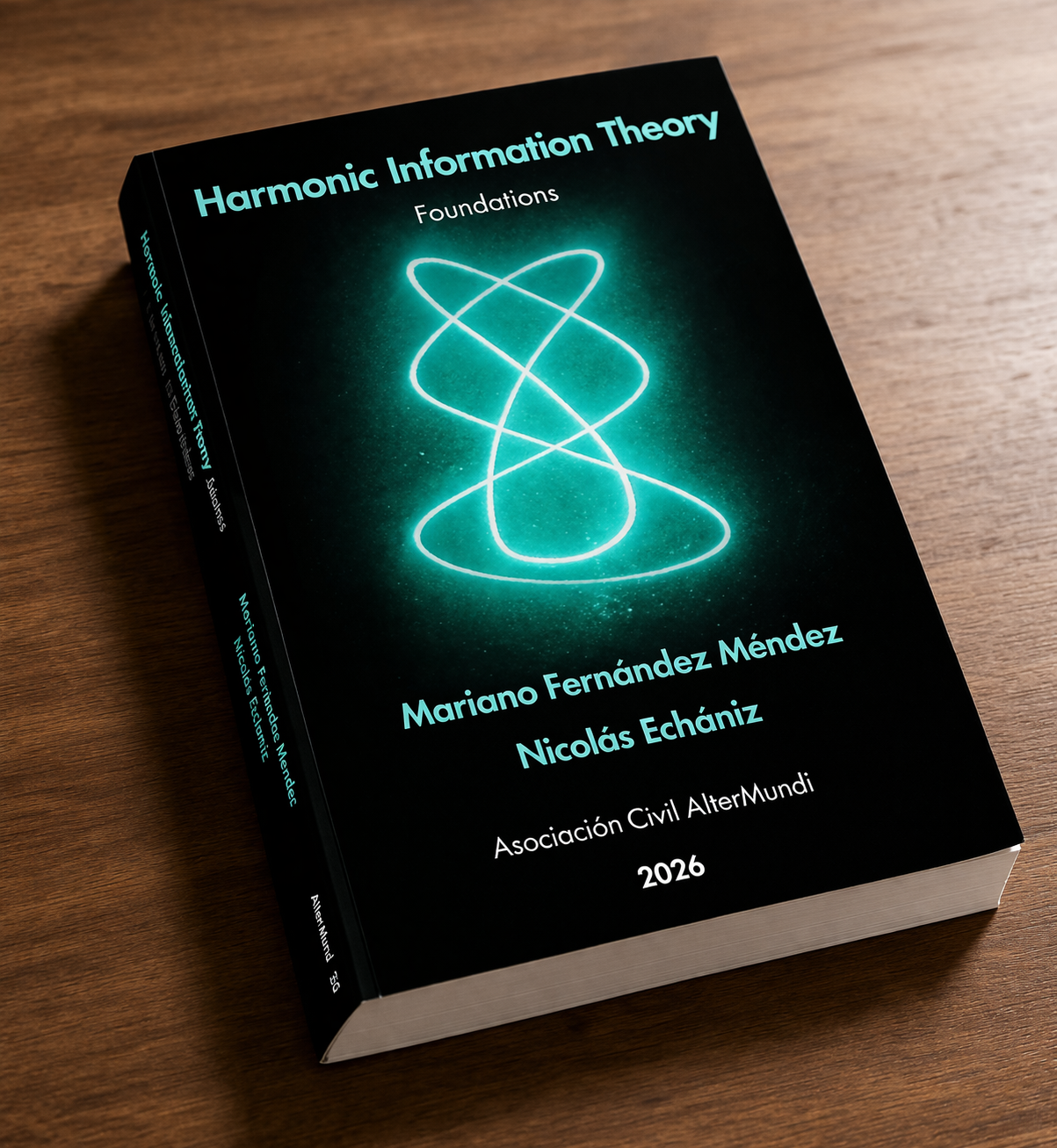
Fernández Méndez, Mariano, and Nicolás Echániz. Harmonic Information Theory: Foundations.
José de la Quintana, Córdoba, Argentina: AlterMundi, 2026. ISBN 978-631-91761-0-0.
https://hit.altermundi.net.
Compilation and final writing: Mariano Fernández Méndez.
Institutional framework: Asociación Civil AlterMundi.
License: CC BY 4.0.
Creative Commons Attribution 4.0 International (CC BY 4.0)
This work may be shared, copied, redistributed, and
adapted, even for commercial purposes, as long as appropriate credit is given, the license is linked, and
changes are indicated. No endorsement by the authors or Asociación Civil AlterMundi should be implied.
Harmonic Information Theory (HIT) explores a simple but ambitious question: can harmonic proportion function as a real organizing principle across nature, perception, and computation? HIT investigates whether structured proportional relations and resonant ratios help stabilize coordination, reduce processing burden, and make complex systems more legible across physical, biological, and computational domains. The framework brings together neuroscience, psychoacoustics, nonlinear dynamics, and machine learning, and develops a linked set of hypotheses about harmony as an informational constraint rather than a merely local feature of signal organization. Two complementary probes anchor that research space: Phideus, a computational model for ratio-guided representation, and Harmonic Beacon, an experiential and physiological probe of sustained harmonic fields. Together, they open a shared language for studying resonance, organization, and informational efficiency across scales.
"One frequency alone can oscillate. Two frequencies can enter into relation. From relation comes interference; from interference, pattern; from pattern, the possibility of differential uptake."
— HIT Foundational Principle
Executive Summary
Across physics, neuroscience, ecology, and computation, researchers keep discovering that structured relations among oscillatory processes matter more than arbitrary descriptions would predict. Simple ratios, resonant couplings, and harmonic patterns appear as privileged constraints on stability, perception, and information processing.
Yet these findings remain scattered across disciplines, each using different vocabularies: neuroscientists speak of "cross-frequency coupling," physicists of "mode locking," ecologists of "acoustic niches," and musicians of "consonance." HIT seeks to coordinate these convergences into a coherent field of inquiry.
Key Insight
Harmonic organization is not merely descriptive—it is informational. Simple ratios function as constraints that make structure more available, reduce processing cost, and enable coordination across scales.
The Six Hypotheses
HIT builds upon six stratified hypotheses, ranging from empirical observations to theoretical conjectures:
H1 Observation
Natural signals contain structured ratio distributions that are not random residue.
H2 Computation
These distributions are learnable by computational systems.
H3 Cross-Modal
Ratio structure is shared across sensory modalities (sound, light, movement).
H4 Efficiency
Simple harmonic ratios correspond to lower processing cost and greater informational efficiency.
H5 Biological
Living systems possess functional sensitivity to consonant organization.
H6 Invariance
The interval or ratio can function as a scale-invariant carrier of information.
Why This Matters
If HIT's hypotheses hold, the implications span multiple domains:
Science: A unified vocabulary for understanding coordination across physics, biology, and cognition.
Technology: New approaches to signal processing, compression, and AI based on harmonic structures rather than symbolic representation.
Health: Understanding how harmonic organization affects physiological states, stress, and well-being.
Ecology: Tools for analyzing and preserving the "biosemiosphere" of acoustic ecosystems.
The Experimental Probes
HIT is not merely theoretical. Two experimental probes test its hypotheses:
Phideus — A computational probe using contrastive learning to test whether harmonic descriptors enable cross-modal learning.
Harmonic Beacon — A physical device that generates controlled harmonic vibrations to test physiological and perceptual responses.
AI-Generated Exploration
An unfiltered look into the theory, generated by AI without team intervention.
La Teoría de la Información Armónica (HIT) explora una pregunta simple pero ambiciosa: ¿puede la proporción armónica funcionar como un principio organizador real a través de la naturaleza, la percepción y la computación? HIT investiga si las relaciones proporcionales estructuradas y los ratios resonantes ayudan a estabilizar la coordinación, reducir la carga de procesamiento y hacer que los sistemas complejos sean más legibles en los dominios físico, biológico y computacional. El marco integra neurociencia, psicoacústica, dinámica no lineal y aprendizaje automático, y desarrolla un conjunto articulado de hipótesis sobre la armonía como restricción informacional, más que como una característica meramente local de la organización de la señal. Dos sondas complementarias anclan ese espacio de investigación: Phideus, un modelo computacional para la representación guiada por ratios, y Harmonic Beacon, una sonda experiencial y fisiológica de campos armónicos sostenidos. Juntos, abren un lenguaje compartido para estudiar la resonancia, la organización y la eficiencia informacional a través de las escalas.
"Una frecuencia sola puede oscilar. Dos frecuencias pueden entrar en relación. De la relación viene la interferencia; de la interferencia, el patrón; del patrón, la posibilidad de captación diferencial."
— Principio Fundacional de HIT
Resumen Ejecutivo
A través de la física, neurociencia, ecología y computación, los investigadores siguen descubriendo que las relaciones estructuradas entre procesos oscilatorios importan más de lo que las descripciones arbitrarias predicen. Los ratios simples, los acoplamientos resonantes y los patrones armónicos aparecen como restricciones privilegiadas sobre la estabilidad, percepción y procesamiento de información.
Sin embargo, estos hallazgos permanecen dispersos entre disciplinas, cada una usando vocabularios diferentes: los neurocientíficos hablan de "acoplamiento entre frecuencias", los físicos de "bloqueo de modo", los ecólogos de "nichos acústicos", y los músicos de "consonancia". HIT busca coordinar estas convergencias en un campo coherente de investigación.
Insight Clave
La organización armónica no es meramente descriptiva—es informacional. Los ratios simples funcionan como restricciones que hacen la estructura más disponible, reducen el costo de procesamiento y permiten la coordinación a través de escalas.
Las Seis Hipótesis
HIT se construye sobre seis hipótesis estratificadas, desde observaciones empíricas hasta conjeturas teóricas:
H1 Observación
Las señales naturales contienen distribuciones de ratios estructuradas que no son residuos aleatorios.
H2 Computación
Estas distribuciones son aprendibles por sistemas computacionales.
H3 Cross-Modal
La estructura de ratios se comparte entre modalidades sensoriales (sonido, luz, movimiento).
H4 Eficiencia
Los ratios armónicos simples corresponden a menor costo de procesamiento y mayor eficiencia informacional.
H5 Biológica
Los sistemas vivos poseen sensibilidad funcional a la organización consonante.
H6 Invarianza
El intervalo o ratio puede funcionar como portador de información invariante a la escala.
Por Qué Importa
Si las hipótesis de HIT se sostienen, las implicaciones abarcan múltiples dominios:
Ciencia: Un vocabulario unificado para entender la coordinación a través de la física, biología y cognición.
Tecnología: Nuevos enfoques para procesamiento de señales, compresión e IA basados en estructuras armónicas en lugar de representación simbólica.
Salud: Entender cómo la organización armónica afecta estados fisiológicos, estrés y bienestar.
Ecología: Herramientas para analizar y preservar la "biosemiosfera" de los ecosistemas acústicos.
Las Sondas Experimentales
HIT no es meramente teórico. Dos sondas experimentales prueban sus hipótesis:
Phideus — Una sonda computacional que usa aprendizaje contrastivo para probar si los descriptores armónicos permiten el aprendizaje cross-modal.
Harmonic Beacon — Un dispositivo físico que genera vibraciones armónicas controladas para probar respuestas fisiológicas y perceptuales.
Hecho con IA sin retoques del equipo
Exploración de la teoría generada por NotebookLM sin intervención humana.